Tuesday, August 31, 2010

Week 2 Hussein Chalayan


1. Chalayan’s works in clothing, like Afterwords (2000) andBurka (1996) , are often challenging to both the viewer and the wearer. What are your personal responses to these works? AreAfterwords and Burka fashion, or are they art? What is the difference?

I personally believe that 'Burka' is more on the art side whereas 'Afterwords' is more fashion. I believe this because art has more of a meaning or message behind but fashion is more about pushing the limits rather than portraying an idea.


2. Chalayan has strong links to industry. Pieces like The Level Tunnel (2006) and Repose (2006) are made in collaboration with, and paid for by, commercial business; in these cases, a vodka company and a crystal manufacturer. How does this impact on the nature of Chalayan’s work? Does the meaning of art change when it is used to sell products? Is it still art?

It makes it more mainstream and almost makes the artist a sellout. Pure artists make work for themselves not others, by doing work for companies it constricts them to boundaries or demands made by that company so its not a true piece to Husseins full potential. It still would be art but now classified as commercial art.


3. Chalayan’s film Absent Presence screened at the 2005 Venice Biennale. It features the process of caring for worn clothes, and retrieving and analysing the traces of the wearer, in the form of DNA. This work has been influenced by many different art movements; can you think of some, and in what ways they might have inspired Chalayan’s approach?

I believe that fashion/wearable art would of been a major influence on 'Absent Presence' by Hussein because it shows how much people care for their clothes in the modern life and how much a few pieces of fabric can mean to a person.


4. Many of Chalayan’s pieces are physically designed and constructed by someone else; for example, sculptor Lone Sigurdsson made some works from Chalayan’s Echoform (1999) and Before Minus Now (2000) fashion ranges. In fashion design this is standard practice, but in art it remains unexpected. Work by artists such as Jackson Pollock hold their value in the fact that he personally made the painting. Contrastingly, Andy Warhol’s pop art was largely produced in a New York collective called The Factory, and many of his silk-screened works were produced by assistants. Contemporarily, Damien Hirst doesn’t personally build his vitrines or preserve the sharks himself. So when and why is it important that the artist personally made the piece?

It is important for the artist to produce a piece of work when its

Semester 2- Week One Nathalie Djurberg's 'Claymations'


1. What do you understand by the word 'claymation'?

I understand the word claymation to mean animation using clay through the process of sculpting. This is the technique such movies like 'Lord of The Rings' and 'Wallace and Gromit' use.

2. What is meant by the term 'surrealistic Garden of Eden'? and 'all that is natural goes away'?

The term 'surrealistic Garden of Eden' means out of the ordinary plants and humans, ones that are unrealistic and have a disturbed and dark feel to them. The term 'all that is nature goes away' means that there is no greenery or any form of nature represented by these claymations.

3. What are the 'complexity of emotions' that Djurberg confronts us with?

I believe that Djurberg leaves us with a variety of emotions, such as confusion, fear and curiosity. Confusion because it leaves the audience confused as to why she would want to create such a piece like this and also confused because there is so much we cant understand about the work. Fear because the pieces are grim and have a dark, intimidating feel to them. And curiosity because we want to know what the plants really are.

4. How does Djurberg play with the ideas of children's stories, and innocence in some of her work?

She does this by using sculptured flowers and children within her works but she adds her own style to it and makes them look slightly deranged and twisted.

5. There is a current fascination by some designers with turning the innocent and sweet into something disturbing. Why do you think this has come about?

I think this has come about because the world is full darkness and misfortune and nobody is really happy. I also believe this because alot of the artwork up until now has had a happy feel toward it in the way other artists use colour and subject etc.

6. In your opinion, why do you think Djurberg's work is so interesting that it was chosen for the Venice Biennale?

I think it was so interesting because there are very few artists of that style and it really sets her aside. Also because i feel that it could almost tell a story, the way the deformed plants almost talk to eachother with all the different textures and colours.

7. Add some of your own personal comments on her work.

I personall really enjoy Djurbergs work as it something you dont see everyday and claymation is very uncommon. She also put a different spin on childrens stories.

Monday, June 7, 2010

Banksy

The artist known as Banksy was born in 1974 and his real name is to be rumored as Robert or Robin Banks. Banksy, himself, on his website he says, "I am unable to comment on who may or may not be Banksy, but anyone described as being 'good at drawing' doesn't sound like me."
He started as a tagger (1992–1994) as one of Bristol's DryBreadZ Crew (DBZ). He was inspired by local artists and his work was part of the larger Bristol underground scene. By 2000 he had moved toward stenciling after realising how much less time it took to complete a piece. Banksy was said to be hiding from the police under a train carriage when he noticed the stenciling serial number and by employing this technique, Bristol and London soon noticed him for his art around the place. A quote from Banksy about his stenciling quotes, "I use whatever it takes. Sometimes that just means drawing a moustache on a girl's face on some billboard, sometimes that means sweating for days over an intricate drawing. Efficiency is the key."

I believe Banksys work is graffiti because it is done illigaly in the streets, which is the definition of graffiti. Another reason i believe this is because graffiti has a purpose or a message to get across to people, which is exactly what banksy achieves. His works consist of mainly stencil work which another reason in why i believe his art is classified as graffiti. A mural is conformist and typical/expected due to the fact you get told what to paint, when to paint, how to paint it and also given permiss to paint that surface, But banksy breaks out of the norm and does what he wants to do and paints the messages he wants to get across to people all whilst being illegal and unkown.

His work is very controversial and political and everybody has a different opinion about, personally i cant get enough of it but others may see it as mindless vandalism. His work can not exactly be sold because it is sprayed onto property in which he doesn't own. Although some of his work that isnt his usual illegal wall sprayed is used for things such as album covers for bands like blur.

http://www.banksy.co.uk/

week 7


The industrial revolution was the time period in which the factory system production emerged, meaning the boom/beginning in the use of machinery to manufacture textiles etc.The Industrial Revolution was a period from the 18th to the 19th century where major changes in agriculture, manufacturing, mining, and transport had a profound effect on the socioeconomic and cultural conditions starting in the United Kingdom, then subsequently spreading throughout Europe, North America, and eventually the world. The onset of the Industrial Revolution marked a major turning point in human history; almost every aspect of daily life was eventually influenced in some way
The work above titles 'Impressionist Sunrise' by Claude Monet relates to the industrial revolution because it was painted shortly after the boom of factories and on the waters edge there is nothing but smoke and large factory chimneys. The loose brush strokes show the intentional inaccuracy of the painting, meaning it doesn't have to be entirely correct to understand the over inflation of the factories on the background

Olafur Eliasson's 'Weather Project' (2006) relates to Claude Monets impressionist sunrise in a number
of ways, such as the way he has tried to keep colour down to a minimum to represent the dullness
of the industrial revolution, i.e big boring factories etc. He has also made the sun the main focus of
his work like monet did in his painting, this shows that the sun is still/and will always be the main
provider of energy.


http://www.webexhibits.org/colorart/monet.html

Wednesday, April 21, 2010

Week 5


Tony Oursler's 'Projeciton Works' began in 1991 when he began dabbling with LCD video projectors, which lead him to create a number of brilliant and controversial works using materials such as hand made cloth figures and animated video projection. His works have a tendency to operate with the viewers empathy/feelings. He projects alot of emotions and expressions onto his works.

Oursler's work can be applied to the enlightenment concepts of Reason, Empiricism, Science, Universalism, Progress, Freedom and Secularism in a number of ways, such as the way he uses projected faces holding alot of emotion to interact with the way people feel about that work (empiricism), i.e. the viewers see the emotions and they feel a sense of empathy for the expression of the projected face.
He also creates work which further the idea that the natural and social condition of human beings could be improved, resulting in an ever increasing level of happiness and well-being, (progress), we see this when Oursler constructed the 'influence machine' in 2000 in Madison Park, NYC and Soho Square, London. This marked his first major outdoor using communication devices such as telegraph to the personal computer as way of speaking with the dead, he used smoke, trees and buildings as projection screens.

References:
http://www.tonyoursler.com/text.php?navItem=text&subsection=All%20Text&page=1
http://images.google.co.nz/images?

Tuesday, April 20, 2010

Week 3


Mercantilism is the system for the major nations that traded goods (e.g. precious metals, gold etc ) during the 16th, 17th and 18th century. This was because national wealth/power was best seen by increasing exports and recieving precious materials, i.e. metals in return.
This has developed since the renaissance by the trade system becoming worldwide and much more common/frequent and much more goods are being exported and recieved rather than precious metals etc.

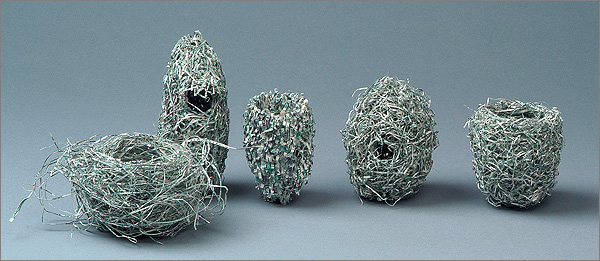
Fiona Hall's work, 'Tender' (2003-2005) relates to the renaissance concept of mercantilism with a number of reasons, firstly being that it represents other cultures of the west in which the australians traded with regularly during the renaissance time period, and with the sculpture consisting of one dollar bills represents the wealth gained within these trades. Secondly, it relates to this renaissance concept of mercantilism because she has grown more wealthier by using money as the sole material for her work, this relates because the in the renaissance era they mainly needed money to become wealthy, but here, she doesnt use it for trading, instead she using it to make art but in return, recieving the same outcome. They sculptures are shaped like the native birds nests of Australian wildlife, this represents the travel/amount of travel that was taken place within trading goods. The money used to make these also symbolise the good/wealth that was accumulated within the renaissance trading period.

The work 'Leaf Litter' (1993-2003) relates to the renaissance concept of mercantilism because the direction of the piece above the notes represents the trading business moving forward and progressing, This relates because the renaissance concept of mercantilism was constantly progressing and furthering their wealth and power.

http://en.wikipedia.org/wiki/Mercantilism

Monday, March 1, 2010