
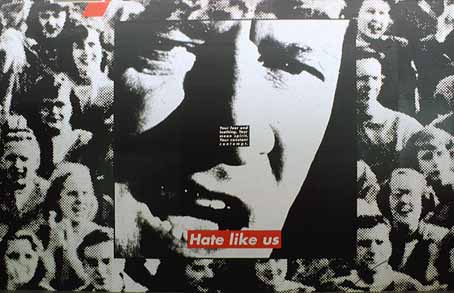
American conceptual/pop artistBarbara Kruger is internationally renowned for her signature black, white and red poster-style works of art that convey in-your-face messages on women's rights and issues of power. Coming out of the magazine publishing industry, Kruger knows precisely how to capture the viewer's attention with her bold and witty photomurals displayed on billboards, bus stops and public transportation as well as in major museums and galleries wordwide. She has edited books on cultural theory, including Remaking History for the Dia Foundation, and has published articles in the New York Times, Artforum, and other periodicals. Monographs on her work include Love for Sale, We Won't Play Nature to Your Culture and others. She is represented in New York by Mary Boone Gallery. A major exhibition of her work will be presented at the Museum of Contemporary Art in Los Angeles in fall 1999, and at the Whitney Museum in New York in 2000.
Research Kruger's work to find an example from the 1970s or 1980s to compare with a more recent work. How has Kruger's work changed with the developments in contemporary visual arts? Describe a recent work that moves away from the 'poster' type work of her early career.
I have found that Kruger seems to be against with the way the humanity is turning out, she portrays this message through her bold and simple works.
I think a spatial piece would impact the audience more than a poster because a poster is a flat 2-dimensional work which can only be seen from one angle, whereas a 3-dimensional installation can be viewed from many different angles, each one being different.
Kruger uses Bold text and simple quotes and sayings which gives her work a strong impact and a sense of personality. Her phrases usually use pronouns such as you, I, your, we and they to adress the audience directly. Much of her text questions the viewer about feminism, classicism, consumerism, and individual autonomy and desire, although her black-and-white images are culled from the mainstream magazines that sell the very ideas she is disputing. Her new work is consistently about the kindnesses and brutalities of social life: about how we are to one another. Her opinions are very hash and blunt and how she reflects them in her work creates strong impact.

No comments:
Post a Comment